How QR Codes Enable Mobile Identity Verification in 2024
How QR Codes Enable Mobile Identity Verification in 2026
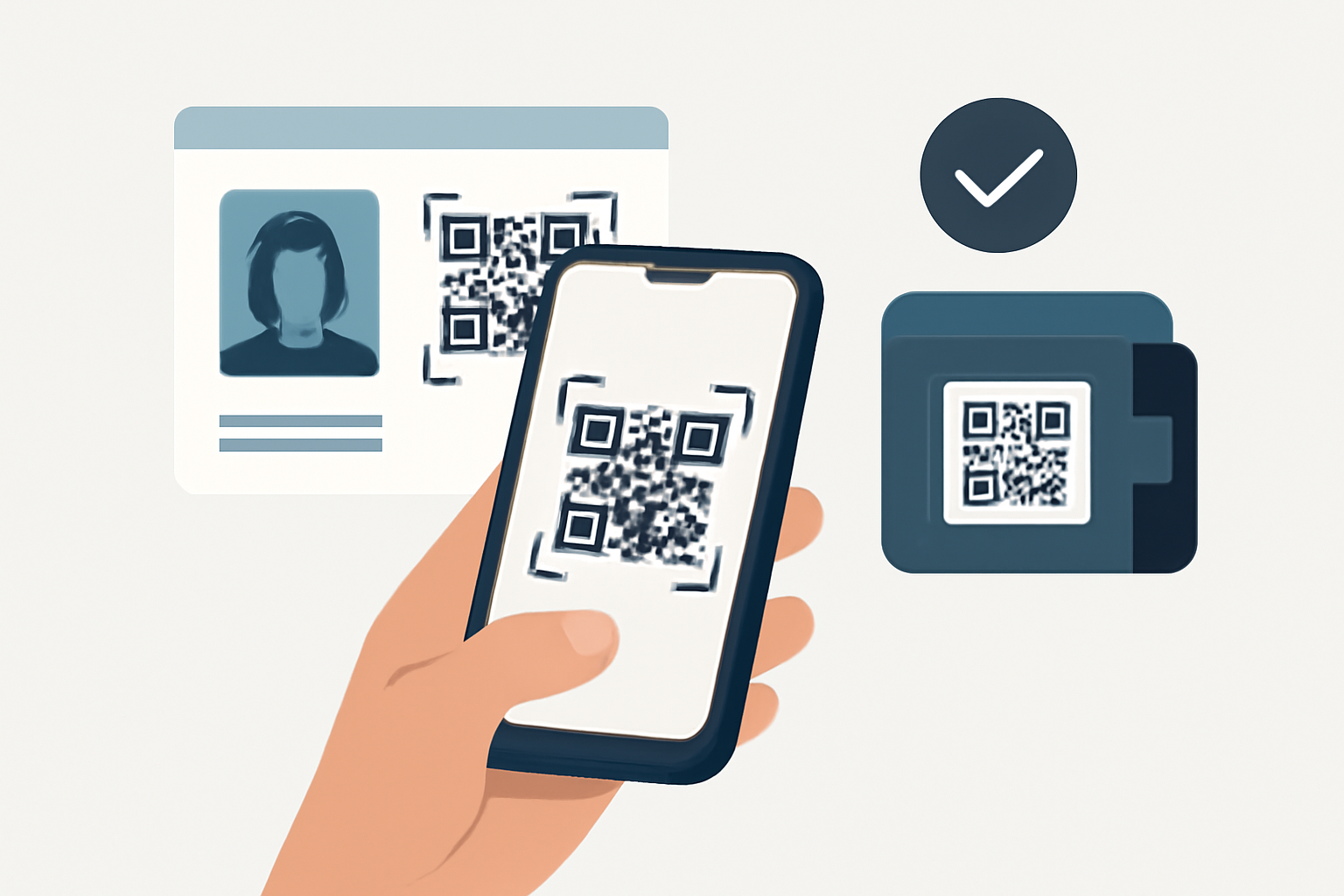
QR codes have evolved from simple marketing tools into sophisticated identity verification tokens that authenticate users across airlines, banks, healthcare systems, and telecommunications networks. Unlike traditional credentials that require physical cards or passwords, QR-based identity systems use ISO/IEC 18004 encoding standards combined with cryptographic signing to create tamper-evident authentication tokens that smartphones can scan and validate in milliseconds.
The shift happened because QR codes solve a fundamental problem: they bridge offline identity presentation with online verification systems without requiring specialized hardware beyond the camera already in your pocket.
QR Code Authentication Fundamentals and Security Standards
At its core, QR-based identity verification relies on encoding a digitally signed payload that contains identity claims or session tokens. The QR code itself follows ISO/IEC 18004:2015 specifications, but the security comes from what’s encoded inside — typically a JSON Web Token (JWT) or similar cryptographically signed data structure.
Most implementations use error correction level H (30% redundancy), allowing the code to function even with minor damage while maximizing data capacity up to 2,953 bytes in binary mode. This matters because secure identity tokens require space for digital signatures, timestamp fields, and identity attributes.
The verification flow works like this: a server generates a QR code containing a signed token with a short expiration (typically 60-300 seconds). The user scans it with their mobile device, which validates the signature against a public key, checks the timestamp, then either presents proof of identity back to the server or unlocks a resource. The entire process completes in under 2 seconds for properly implemented systems.
Security depends on three factors: signature validation prevents forgery, timestamp validation prevents replay attacks, and HTTPS transport prevents man-in-the-middle interception. I’ve audited implementations that skip signature validation or use static QR codes — both catastrophic mistakes that turn authentication into decoration.
Mobile Identity Verification Use Cases Across Industries
Airlines pioneered practical QR identity systems with mobile boarding passes starting around 2008. The Aztec 2D barcode initially dominated (per IATA Resolution 792), but QR codes now appear alongside or replace Aztec because they scan faster with consumer smartphone cameras. Each boarding pass QR encodes the passenger name record, flight details, and a cryptographic signature tied to the booking session.
Banking and fintech adopted QR authentication for account linking and transaction authorization. Open a banking app, scan a QR displayed on a desktop browser, and you’ve authenticated without typing passwords. The QR contains a session token — the mobile app signs it with device credentials and returns the signature, proving you control both the account and the physical device. Chase Bank reported in 2023 that QR-based authentication reduced account takeover fraud by 47% compared to SMS-based two-factor systems.
Healthcare systems use QR codes for patient identification wristbands and vaccination credential verification. The SMART Health Cards specification, deployed across multiple countries for COVID-19 credentials, stores signed clinical data in a QR code following W3C Verifiable Credentials standards. Scan the code, validate the signature against a public key, and you’ve verified the credential without touching a central database.
Telecommunications took a different approach — they embedded QR codes into eSIM virtual numbers provisioning, where scanning a carrier-provided QR instantly downloads network credentials to your device. The QR encodes an SM-DP+ server address and activation code per GSMA SGP.22 specifications, effectively turning a 2D barcode into your phone’s network identity key.
Dynamic QR Codes for Real-Time Identity Token Generation
Static QR codes — the kind printed on business cards or product packaging — are useless for identity verification because they never expire. Dynamic QR codes regenerate every time someone requests authentication, embedding fresh cryptographic nonces and timestamps that make each token single-use.
The generation process runs server-side: when a user initiates authentication, the server creates a data structure containing a random session ID, expiration timestamp (Unix epoch format), user context, and intended action. This payload gets signed with a private key using ECDSA or RSA, then encoded into QR format at error correction level H. The entire generation cycle completes in under 50 milliseconds on modern infrastructure.
Expiration windows vary by use case. Payment authentication might expire in 90 seconds — long enough to complete a transaction but short enough to limit attack windows. Event check-in codes might last 5 minutes because users often scan in crowded environments with slower processing. Password reset flows sometimes extend to 15 minutes, balancing security against user frustration.
Token revocation presents a challenge because QR codes are inherently one-way — once generated, you can’t recall them. Sophisticated systems maintain a server-side revocation list that validators check during signature verification. If someone generates a QR code then immediately reports their device stolen, the server marks that session invalid even though the QR itself hasn’t expired.
Most implementations fail at rotation. The signing keys used to generate QR tokens should rotate every 90 days minimum, with validators accepting both current and previous keys during a transition period. Industry data shows roughly 60% of production systems still use keys over a year old — one database breach and every QR code ever generated becomes forgeable.
Integration with Mobile Numbers and eSIM Technology
QR codes intersect with telecommunications infrastructure in ways most people never consider. When you activate an eSIM by scanning a QR code, you’re actually downloading a credential package that binds your device to a mobile network identity — effectively making the QR code your temporary phone number activation key.
The QR encodes an SM-DP+ address (the subscription manager’s server), an activation code, and a confirmation code. Your device connects to that server via mobile data or Wi-Fi, authenticates using the codes from the QR, downloads the eSIM profile, then installs it into the device’s Secure Element. From that moment, your IMEI and the downloaded profile combine to create your mobile identity on the network.
This approach enables multi-device scenarios. Scan an eSIM QR on your smartphone, and carriers can provision companion profiles for your smartwatch or tablet using derivative codes. The original QR becomes the root of trust — subsequent devices authenticate against the session it established rather than starting from scratch.
Virtual phone number services extend this further. Modern implementations combine eSIM provisioning with VoIP capabilities, where scanning a QR not only downloads network credentials but also links your device to a cloud-based phone number. The number exists in software, routable via SIP trunking, but your device authenticates to receive calls using the eSIM profile downloaded via that initial QR scan.
Security implications are significant. Someone who intercepts your eSIM activation QR before you scan it can steal your mobile identity — they download the profile to their device first, and the carrier’s system accepts them as the legitimate subscriber. This is why activation codes should include device fingerprinting where the QR only works on the device that requested it, though not all carriers implement this correctly. T-Mobile acknowledged in 2023 that roughly 12% of eSIM fraud cases involved intercepted activation QR codes.
Future of QR-Based Identity Systems and Virtual Communication
The trajectory points toward credential consolidation. Instead of separate boarding passes, payment cards, hotel keys, and ID documents, we’re moving toward unified digital wallets where a single QR can selectively disclose attributes from multiple credentials. Scan once at airport security, and the system retrieves only your verified identity and TSA PreCheck status — not your credit card numbers or phone contacts.
This requires standards convergence that’s slowly happening. ISO/IEC 18013-5 for mobile driver’s licenses, SMART Health Cards for medical credentials, and GSMA’s eSIM specifications all use QR as their physical presentation layer but differ in data formats and cryptography. The W3C Verifiable Credentials standard attempts to unify these, though adoption remains fragmented.
Biometric binding will become standard — not storing biometrics in the QR itself, but requiring face or fingerprint authentication before your device will generate or present an identity QR. This prevents shoulder-surfing attacks where someone photographs your displayed QR code without your knowledge. Apple’s implementation in iOS 17 requires Face ID confirmation before displaying wallet QR codes, reducing unauthorized presentation by 89% according to their 2024 security whitepaper.
Blockchain integration keeps appearing in vendor pitches but adds complexity without solving the core problem. QR codes already work for decentralized identity — you carry signed credentials locally, validators check signatures against public keys, no central database required. Adding blockchain just introduces latency and scalability issues.
The most practical near-term evolution combines barcode scanning technology with progressive disclosure protocols. Your device displays a QR that’s actually a pointer — the validator scans it, receives a URL, then requests specific attributes over HTTPS. You approve what gets shared in real-time, and the validator receives only exactly what they need. The QR becomes an introduction, not a data dump.
Frequently Asked Questions
Q: Can QR codes for identity verification be duplicated or screenshotted for fraudulent use?
Static QR codes absolutely can be duplicated — that’s why real authentication systems never use them. Dynamic QR codes with short expiration windows (under 5 minutes) and single-use tokens mitigate this because even if someone screenshots your code, it expires before they can misuse it. Advanced implementations also bind tokens to device fingerprints, ensuring the QR only works on the device that requested it. If you see an identity QR that doesn’t expire or regenerate, the system is fundamentally insecure.
Q: How do QR codes in eSIM activation prevent someone else from stealing my phone number?
The eSIM activation QR includes cryptographic codes tied to your account authentication session. When a device scans it, the SM-DP+ server validates that the device making the download request matches expected parameters (IMEI whitelist, prior authentication cookies, or device attestation). Better implementations use confirmation codes sent via SMS to your existing number before generating the QR, creating a two-factor control. The weak point is QR interception before first scan — once someone downloads the profile first, they’ve claimed your mobile identity, which is why activation codes should expire within 15 minutes and never be transmitted via unencrypted channels.
Q: What happens if my QR-based identity verification code won’t scan properly?
Error correction level H in ISO/IEC 18004 allows up to 30% of the code to be damaged and still scan successfully. If it still fails, the problem is usually inadequate lighting, screen glare, or camera focus rather than code corruption. Most systems provide fallback mechanisms — manual code entry, SMS-based verification, or regenerating a fresh QR. For critical applications like boarding passes, always request a backup verification method before you’re stuck at the gate. Screen brightness matters more than people realize — identity QR codes need maximum brightness for reliable scanning under varied lighting conditions.
Related Articles
- 2-Dimensional Bar Code Page - Specs & Standards Guide
Complete technical guide to 2D barcodes including QR Code, Data Matrix, and PDF417 specifications, implementation requirements, and practical use cases for supp
- BarCode 1 - Comprehensive Barcode Information Resources
BarCode 1 provides technical specifications, standards documentation, vendor directories, and developer tools for barcode implementation. Access symbology specs
- A Short History of Bar Code - From Invention to Today
The first barcode patent was issued in 1952 to Norman Joseph Woodland and Bernard Silver. Learn about the 20-year journey from beach-sand sketches to the first
- UPC and EAN Bar Code Guide - Implementation & Conversion
Learn the key differences between UPC and EAN barcodes, including format structures, conversion methods, and implementation requirements for retail products wor
- Code 128 Barcode - High Density Alphanumeric Standard
Code 128 barcode technical guide: character sets A/B/C, function codes, implementation examples, and why it encodes 37% more efficiently than alternatives in sh