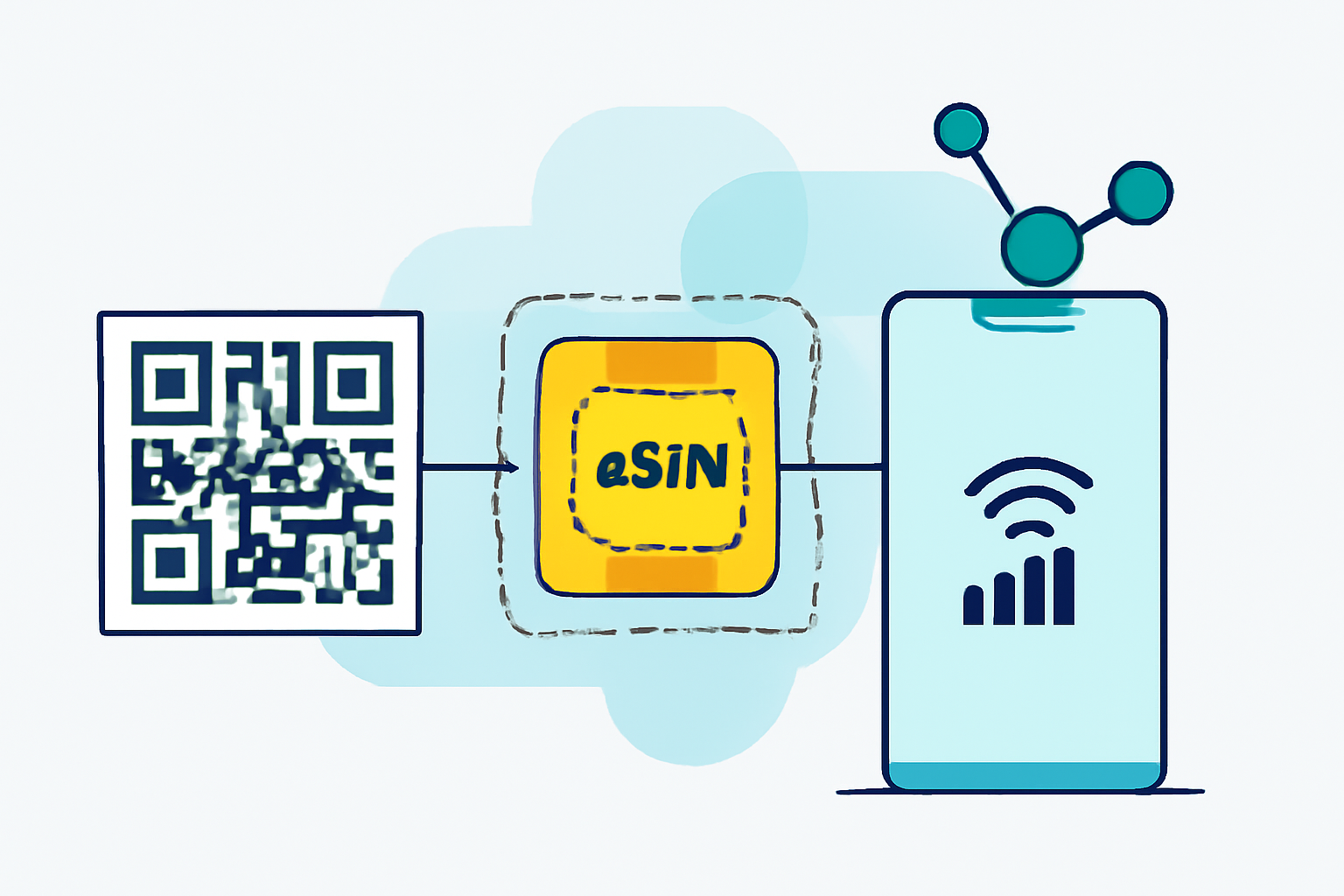
QR Code eSIM Activation: How Barcode Technology Powers Virtual SIM Provisioning
How eSIM QR Codes Work: Technical Standards and Activation Process
QR codes have transformed eSIM activation into a simple scan-and-connect process, encoding the complete profile download instructions into a machine-readable matrix barcode. When you scan an eSIM activation QR code, your device extracts an SM-DP+ server address and encrypted authentication token, initiating an automated provisioning sequence that downloads carrier credentials and network parameters directly to your device’s embedded Universal Integrated Circuit Card (eUICC). This eliminates physical SIM cards entirely, reducing activation time from days to seconds.
The technology represents a convergence point between barcode standards and telecommunications infrastructure—QR Code Model 2 symbology carrying GSMA-standardized activation strings that reconfigure mobile network access. Understanding this technical bridge reveals how 2D barcode technology now underpins the modern mobile identity ecosystem.
eSIM QR Code Structure and Embedded Activation Data
An eSIM activation QR code contains a specifically formatted string beginning with “LPA:” (Local Profile Assistant), followed by a base64-encoded activation code. The standard structure includes three critical components: the SM-DP+ (Subscription Manager Data Preparation) server address where your carrier profile resides, a unique matching identifier linking you to that profile, and an optional confirmation code for additional security verification.
The typical format looks like: LPA:1$SM-DP+.SERVER.COM$MATCHING-ID$CONFIRMATION-CODE. This string typically runs 100-200 characters, well within QR Code capacity—even a Version 10 QR code at medium error correction stores 1,852 alphanumeric characters. Most activation codes use Version 5-7, balancing data capacity with scan reliability on device cameras.
The QR code itself follows ISO/IEC 18004 specifications for Quick Response codes, employing Reed-Solomon error correction to ensure accurate scanning even with 15-30% code damage depending on error correction level. Carriers typically generate these codes at Level M (15% restoration capability), prioritizing smaller code size for better display and scanning performance on mobile screens.
The beauty of this design is the complete decoupling of activation media from provisioning infrastructure. The QR code is simply a delivery vehicle—the actual profile data never touches the barcode. Your device uses the extracted string to authenticate with the carrier’s remote server, which then pushes the encrypted profile through a secure channel. This architecture means the same activation mechanism works whether you receive the QR code via email, printed on paper, or displayed on a website.
GSMA Standards for QR-Based Mobile Profile Provisioning
The GSMA (GSM Association) defines eSIM activation protocols in its RSP (Remote SIM Provisioning) specification, specifically SGP.22 for consumer devices. This standard mandates the QR code format structure, authentication protocols, and profile encryption requirements that ensure interoperability between any carrier and any eSIM-capable device worldwide.
Under SGP.22 v2.2 and later, the QR-encoded activation code triggers a specific handshake sequence. Your device’s Local Profile Assistant (LPA) software—built into iOS 12+ and Android 9+—parses the code, establishes a TLS 1.2+ encrypted connection to the SM-DP+ server, and exchanges ES8+ protocol messages to authenticate and download the profile. The specification requires mutual authentication: your device proves it’s a legitimate eUICC, and the server proves it’s authorized to provision profiles for that carrier.
The standard also defines fallback mechanisms. If QR scanning fails, users can manually enter the activation code—which is why you’ll often see the full string printed below the QR code. Some implementations support direct “Activation Code” entry in device settings, bypassing QR scanning entirely while using the identical underlying string format.
Most users don’t realize they’re interacting with a sophisticated barcode standard when they scan an eSIM QR code. The GSMA deliberately designed the experience to feel effortless, hiding the technical complexity behind a familiar scanning gesture. I’ve found this demonstrates how mature barcode technology has become—the implementation remains invisible to end users while maintaining rigorous technical standards underneath.
Scanning Process Flow from Code Detection to Network Connection
The activation sequence begins when your device camera detects the QR pattern and your operating system recognizes the “LPA:” prefix. On iOS, this immediately triggers the eSIM setup assistant; Android displays a prompt to add the cellular plan. This pattern recognition happens before full code parsing—a smart usability touch that provides instant feedback.
Once you confirm activation, the device’s LPA extracts the SM-DP+ address and matching ID, then initiates an HTTPS connection to that server. The eUICC chip generates a device-specific cryptographic challenge, proving it’s a genuine embedded secure element. The SM-DP+ responds with a signed profile package encrypted specifically for that eUICC—this profile cannot be intercepted and used on different devices.
The profile download transfers carrier-specific data:
- IMSI (International Mobile Subscriber Identity)
- Network authentication keys (Ki)
- Carrier certificates
- Network selection rules
- Service access credentials
This typically requires 50-150KB of data transfer, completing in seconds on WiFi or existing cellular connections. The eUICC stores this encrypted profile in tamper-resistant memory, keeping multiple profiles isolated from each other and the device operating system.
After successful download, the device performs network registration using the new credentials. Your phone connects to the carrier’s nearest cell tower, authenticates using the provisioned Ki, and establishes a data and voice connection. From QR scan to active connectivity typically takes 30-90 seconds—comparing favorably to physical SIM activation which requires shipping, manual installation, and often device restarts.
This entire flow demonstrates why QR codes became the preferred delivery mechanism. Unlike NFC tag-based provisioning (which requires specialized hardware) or manual code entry (prone to transcription errors), camera-based QR scanning uses existing smartphone capabilities while maintaining high accuracy through error correction. The approach scales from budget Android devices to flagship iPhones using identical barcode standards.
Security Considerations in QR-Based eSIM Distribution
QR code delivery introduces specific security considerations absent in physical SIM distribution. The activation code itself is essentially a bearer token—anyone with access can attempt activation. Smart implementations address this through confirmation codes (the optional fourth parameter in the LPA string), which require user knowledge to complete provisioning. Some carriers add email verification steps before displaying the QR code.
The GSMA standard mandates encryption of the profile package itself, not the activation code. This is deliberate: the QR string is considered semi-public information, similar to a URL. The real security resides in the cryptographic binding between profile and specific eUICC. Even if an attacker intercepts your QR code, they cannot install the resulting profile on unauthorized hardware—the SM-DP+ server verifies eUICC identity before releasing encrypted credentials.
Certificate pinning and server authentication prevent man-in-the-middle attacks during profile download. The device validates the SM-DP+ server’s TLS certificate against known carrier certificate authorities before transmitting any eUICC information. This bidirectional authentication creates a secure channel resistant to network-level interception, crucial when provisioning over public WiFi.
However, QR code phishing represents a real threat vector. Malicious actors can generate fake eSIM QR codes that direct devices to rogue SM-DP+ servers. While these cannot extract existing profiles (eUICC secure elements prevent external reading), they could potentially provision tracking profiles or intercept communications. Legitimate virtual phone number solutions implement additional verification layers—email confirmation, account authentication, and transparent server certificates—to mitigate these risks.
Organizations distributing bulk eSIM activations should treat QR codes like passwords: transmitted through secure channels, potentially rate-limited, and ideally with confirmation codes required. Email delivery with view-once links provides better security than public web pages with permanent QR code displays.
Benefits of QR Activation for Virtual Communication Services
QR-based provisioning eliminated the primary friction point in mobile connectivity: physical logistics. Virtual carriers and eSIM providers can now onboard customers globally without managing inventory, shipping, or physical retail presence. You purchase a data plan from a website, receive a QR code by email, and activate within minutes—this operational simplicity enables business models impossible with physical SIMs.
For multi-device identity management, QR activation supports the mobile scanning technology that enables users to provision smartphones, tablets, smartwatches, and laptops from centralized account dashboards. The same barcode standard works across device categories, creating consistency in the user experience whether activating an iPhone, Samsung Galaxy Watch, or Surface Pro with cellular.
The approach scales particularly well for temporary connectivity needs: international travel eSIMs, event-specific data plans, or IoT device provisioning. Carriers generate activation codes on-demand through automated systems, delivering them via email, SMS, or account portals. This eliminates the multi-day lead time associated with physical SIM shipping, matching the immediate gratification expectations of digital consumers.
From a technical perspective, QR activation also simplifies device manufacturing and inventory management. Smartphones ship without carrier-specific SIMs, reducing SKU complexity and enabling “late-stage customization”—the device remains carrier-agnostic until the customer scans their preferred provider’s QR code. This flexibility benefits both manufacturers and retailers managing global supply chains.
The technology has proven robust enough for enterprise deployments. Companies provisioning thousands of corporate devices can batch-generate QR codes through carrier APIs, distribute them through mobile device management systems, and track activation status programmatically. This level of automation wasn’t feasible with physical SIM distribution, which required manual handling at every step.
Frequently Asked Questions
Q: Can I use the same eSIM QR code multiple times or on different devices?
Most activation codes are single-use by design—once successfully scanned and provisioned, the SM-DP+ server marks that profile as downloaded and invalidates the QR code. This prevents unauthorized duplication. However, some carriers issue reusable codes for specific use cases like device replacements, where you need to transfer the same profile to new hardware. The distinction depends on carrier implementation: consumer plans typically use single-use codes, while enterprise deployments may use multi-device codes tied to a pool of available profiles. Always check with your provider whether you need a new QR code when switching devices.
Q: What happens if my eSIM QR code won’t scan properly?
Start by ensuring adequate lighting and holding your device 6-12 inches from the code—QR scanning accuracy depends on focus and contrast. If camera scanning fails repeatedly, look for the manual entry option in your device’s cellular settings (usually under “Add Cellular Plan” or “Add eSIM”). The full activation string printed below the QR code can be typed directly, though it’s tedious. Alternatively, some carriers offer in-app activation that uses authenticated API calls instead of QR codes, bypassing camera scanning entirely. If none of these work, contact your carrier—the profile may have expired or been provisioned incorrectly on their end. Activation codes typically have 30-90 day validity periods before carriers purge them from SM-DP+ servers.
Q: Are there security risks if someone takes a photo of my eSIM QR code before I use it?
Yes, this is why you should treat activation QR codes like sensitive credentials. Anyone with the code can attempt activation on their device. However, carriers implement safeguards: most codes are single-use (first successful activation locks it), some require confirmation codes known only to you, and enterprise deployments often add device whitelisting. The profile itself is encrypted for your specific eUICC, so even if someone activates it, they cannot extract your credentials or use them elsewhere. Still, best practice is keeping QR codes private until activation completes, then securely deleting or destroying the code. For high-security applications, request confirmation code protection from your carrier.
Related Articles
- 2-Dimensional Bar Code Page - Specs & Standards Guide
Complete technical guide to 2D barcodes including QR Code, Data Matrix, and PDF417 specifications, implementation requirements, and practical use cases for supp
- BarCode 1 - Comprehensive Barcode Information Resources
BarCode 1 provides technical specifications, standards documentation, vendor directories, and developer tools for barcode implementation. Access symbology specs
- A Short History of Bar Code - From Invention to Today
The first barcode patent was issued in 1952 to Norman Joseph Woodland and Bernard Silver. Learn about the 20-year journey from beach-sand sketches to the first
- UPC and EAN Bar Code Guide - Implementation & Conversion
Learn the key differences between UPC and EAN barcodes, including format structures, conversion methods, and implementation requirements for retail products wor
- Code 128 Barcode - High Density Alphanumeric Standard
Code 128 barcode technical guide: character sets A/B/C, function codes, implementation examples, and why it encodes 37% more efficiently than alternatives in sh