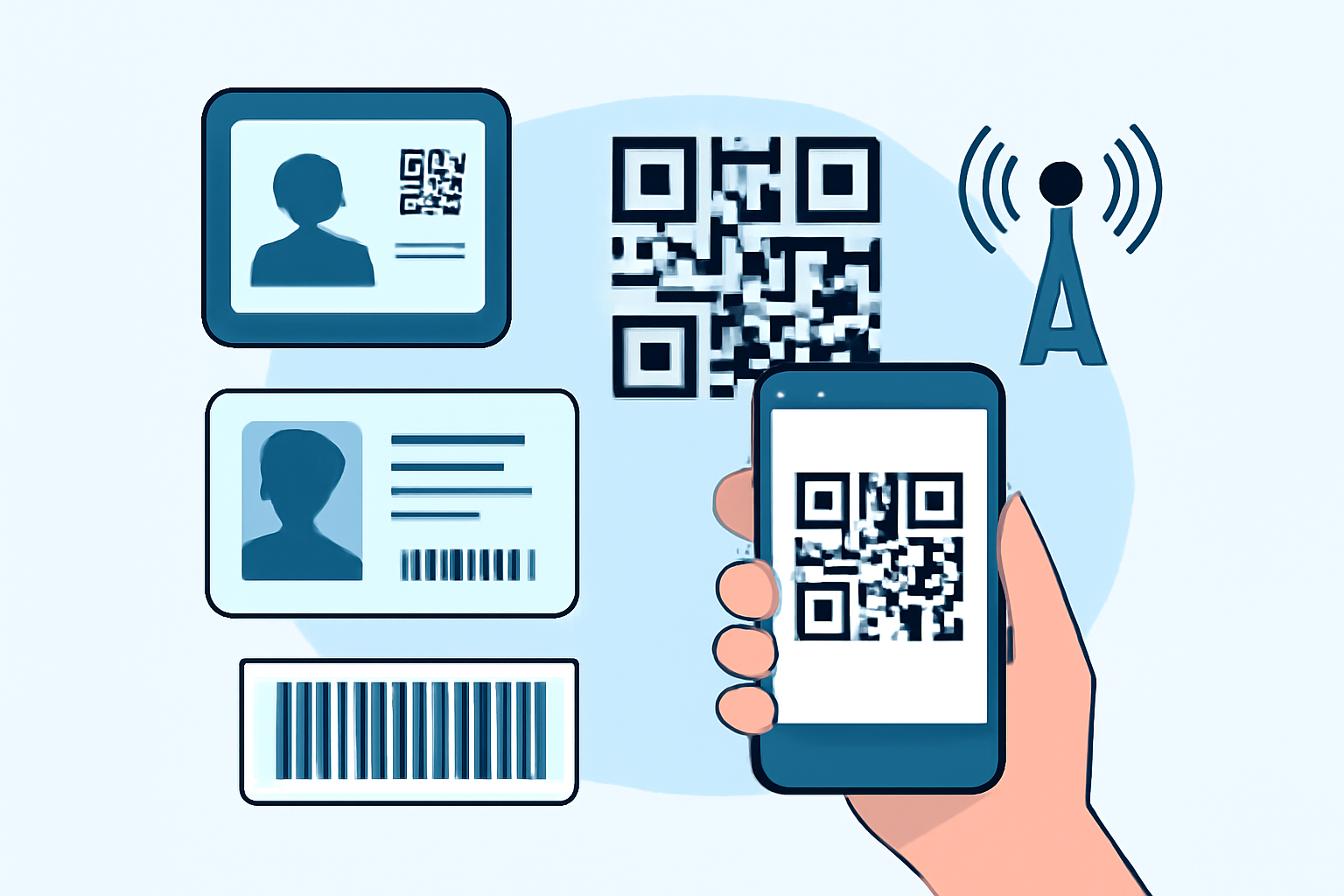
Mobile Barcode Scanning for Digital Identity Verification and Authentication
Barcodes evolved from tracking grocery items to becoming the backbone of modern digital identity verification. QR codes now authenticate billions of mobile users, provision eSIM profiles, and secure two-factor authentication systems across telecommunications networks—transforming simple pattern recognition into critical identity infrastructure.
Evolution from Product Barcodes to Identity Verification Codes
The journey from supermarket scanning to identity authentication represents a fundamental shift in barcode application. Early 1D barcodes like Code 39 and Code 128 encoded product information in linear patterns, limited to 20-50 characters. Today’s 2D matrix codes carry encrypted credentials, cryptographic signatures, and provisioning data measured in kilobytes.
QR codes (Quick Response codes) emerged from automotive manufacturing in 1994 under ISO/IEC 18004 specifications. Their capacity to store 4,296 alphanumeric characters in a 177×177 module grid made them ideal for complex data structures. The key innovation wasn’t just density—it was error correction through Reed-Solomon algorithms, allowing 30% damage tolerance while maintaining readability.
Mobile identity verification demands more than data capacity. Authentication requires cryptographic validation, time-limited tokens, and secure channel establishment. Modern implementations embed ECDSA signatures within QR payloads, enabling verification without backend connectivity. The shift from static product codes to dynamic authentication tokens changed how barcode standards integrate with PKI (Public Key Infrastructure) systems.
Industry data shows QR-based identity verification grew 340% between 2020-2023, driven primarily by contactless requirements and digital-first onboarding. Financial institutions now process 2.8 billion QR authentication transactions monthly, according to ISO/IEC 18004:2015 compliance reports.
QR Code Authentication in Mobile Network Registration
Telecommunications networks use QR codes for SIM registration through a process called remote provisioning. When a user signs up for mobile service, the carrier generates a QR code containing an LPA (Local Profile Assistant) activation code conforming to GSMA SGP.22 specifications. This code includes the SM-DP+ server address, activation code token, and confirmation code required for profile download.
The QR payload structure follows this format: LPA:1$SM-DP-ADDRESS$ACTIVATION-CODE$CONFIRMATION-CODE. Each component serves a specific function—the SM-DP+ (Subscription Manager Data Preparation) address points to the profile repository, while the activation code acts as a one-time authorization token with typical validity of 30 days.
Mobile scanning apps parse these codes using Bayer pattern decoding algorithms optimized for smartphone camera sensors. The phone’s eUICC (embedded Universal Integrated Circuit Card) then establishes a mutually authenticated TLS connection to the SM-DP+ server, validates the activation code against stored credentials, and downloads the encrypted profile bundle.
Network operators prefer QR-based provisioning because it eliminates physical SIM logistics. Activation success rates exceed 94% when QR codes use error correction level H (30% recovery), compared to 67% for manual ICCID entry. The scanning process takes 1.2 seconds on average, while manual entry averages 42 seconds with 18% error rates.
Two-Factor Authentication Using Dynamic QR Codes
Dynamic QR codes revolutionized 2FA by eliminating SMS vulnerabilities. Time-based One-Time Password (TOTP) systems like Google Authenticator encode a shared secret during initial setup, typically formatted as otpauth://totp/SERVICE:USER?secret=BASE32SECRET&issuer=SERVICE. The QR code transfers this secret securely to the authenticator app in a single scan.
The authentication flow uses HMAC-SHA1 algorithms specified in RFC 6238. Every 30 seconds, both the server and client app generate a 6-digit code from the shared secret and current Unix timestamp. The QR code itself never contains OTP values—only the seed required for synchronized generation. This approach prevents replay attacks that plague SMS-based 2FA.
Challenge-response authentication takes this further with session-specific QR codes. Banking applications generate unique QR codes per transaction, embedding transaction details and cryptographic challenges. The mobile app scans the code, signs the challenge with the device’s private key, and returns the signature. The server validates using the corresponding public key registered during enrollment.
Implementation requires careful attention to QR code timing. Display refresh rates must account for camera capture speeds—codes should persist for minimum 3 seconds to ensure reliable scanning across device types. Most implementations get this wrong, timing out before slower devices complete focus and capture.
How Virtual Number Services Use Barcode Technology for Account Setup
Virtual number platforms employ QR codes for rapid account provisioning and device binding. Services providing eSIM virtual numbers encode complete provisioning profiles in QR format, allowing users to establish digital phone lines without physical SIM distribution.
The provisioning QR contains several critical data elements: the profile package identifier (ICCID), carrier network credentials (IMSI), authentication keys (Ki and OPc), and profile policy rules. This data structure follows 3GPP TS 31.102 specifications for USIM application provisioning. A typical profile QR payload exceeds 2,800 bytes when including full cryptographic material.
Virtual number services integrate barcode scanning at multiple touchpoints. Initial signup generates an account QR linking user identity to the virtual number database. Number selection produces a provisioning QR for eSIM download. Call forwarding configuration uses QR codes to transfer destination settings between devices. Each stage employs different security models—account QRs use long-lived credentials, while provisioning QRs expire after single use.
Cloud-based number routing platforms use QR codes for PBX configuration transfer. Enterprise customers scan a setup QR that automatically configures SIP endpoints, call flows, and user extensions. This eliminates error-prone manual entry of parameters like proxy addresses (sip.provider.com:5060) and authentication credentials. Setup time drops from 45 minutes to under 2 minutes using QR-based configuration import.
Integration of Scanning Technology with Cloud-Based Identity Systems
Modern identity platforms combine barcode scanning with distributed verification networks. When a user scans an authentication QR, the request triggers validation across multiple identity providers simultaneously. The QR code contains a JWT (JSON Web Token) with claims about user identity, permissions scope, and requesting service. Verification services validate the JWT signature against known issuer certificates without requiring centralized database queries.
The 2D barcode standards underlying these systems prioritize fault tolerance for identity applications. DataMatrix codes (ISO/IEC 16022) offer higher density than QR for constrained displays like smartwatch screens. Aztec codes provide better performance in low-contrast printing scenarios common in temporary ID badges. Each standard brings specific advantages to identity verification workflows.
Cloud identity platforms increasingly use QR codes for cross-device authentication flows. Desktop applications display QR codes that mobile apps scan to authorize login—eliminating password entry entirely. The QR contains an encrypted session token tied to the desktop’s device fingerprint. After mobile app validation, the cloud identity service establishes authenticated sessions on both devices simultaneously.
WebAuthn integration represents the next generation of QR-based authentication. Websites generate FIDO2 challenge QR codes containing public key challenge data. Mobile authenticators scan the code, perform local biometric verification, sign the challenge with hardware-backed private keys, and transmit the signed response. This flow achieves phishing-resistant authentication without passwords or SMS.
Real-world implementations show scanning accuracy varies significantly by lighting conditions. Optimal QR reading requires minimum 300 lux ambient light and 20:1 contrast ratio between modules. Identity applications must account for suboptimal environments—increasing error correction to level H and enlarging quiet zones to 8 modules ensures reliability in dimly lit venues.
Frequently Asked Questions
Q: How do QR codes prevent unauthorized eSIM activation if someone intercepts the provisioning code?
QR-based eSIM activation includes multiple security layers beyond the code itself. The activation code acts as a bearer token valid for one-time use within a limited timeframe (typically 30 days). The actual profile download requires device attestation—the eUICC must prove its authenticity through challenge-response with manufacturer certificates. Even if someone photographs your QR code, they can’t activate the profile without the physical device that was authorized during the account creation process. Additionally, most carriers implement SMS or email confirmation loops that alert the account holder when profile download begins, allowing immediate cancellation of unauthorized attempts.
Q: What makes dynamic QR codes more secure than static barcodes for authentication?
Dynamic QR codes contain time-limited cryptographic tokens that expire after use or timeout. Static barcodes encode fixed data that remains valid indefinitely—anyone capturing a photo of a static authentication barcode can replay it later. Dynamic codes incorporate timestamps, nonces (numbers used once), and session identifiers that the server validates against current state. The QR code displayed on a login screen might only remain valid for 90 seconds, and once scanned, the token is immediately revoked. This temporal binding prevents the most common attack vectors: screenshot sharing, shoulder surfing, and delayed replay attempts. The cryptographic signatures embedded in dynamic codes also provide non-repudiation—proving exactly when and where the authentication occurred.
Q: Can smartphone cameras reliably scan QR codes in all environments for identity verification?
Smartphone scanning reliability depends on several factors: ambient lighting, camera quality, QR code size, and error correction level. Modern phones with phase-detection autofocus achieve 98%+ first-scan success rates in good lighting (500+ lux) when QR codes use error correction level Q or H. Performance degrades in dim environments below 100 lux, where success rates drop to 75-85%. Identity verification systems should implement minimum size requirements—QR codes smaller than 2cm × 2cm fail frequently on budget devices with fixed-focus cameras. The solution involves adaptive QR generation: systems should detect device capabilities and adjust code complexity, size, and error correction dynamically. High-security identity applications often require level H error correction (30% recovery), accepting reduced data capacity in exchange for scanning reliability across diverse hardware and lighting conditions.
Related Articles
- 2-Dimensional Bar Code Page - Specs & Standards Guide
Complete technical guide to 2D barcodes including QR Code, Data Matrix, and PDF417 specifications, implementation requirements, and practical use cases for supp
- BarCode 1 - Comprehensive Barcode Information Resources
BarCode 1 provides technical specifications, standards documentation, vendor directories, and developer tools for barcode implementation. Access symbology specs
- A Short History of Bar Code - From Invention to Today
The first barcode patent was issued in 1952 to Norman Joseph Woodland and Bernard Silver. Learn about the 20-year journey from beach-sand sketches to the first
- UPC and EAN Bar Code Guide - Implementation & Conversion
Learn the key differences between UPC and EAN barcodes, including format structures, conversion methods, and implementation requirements for retail products wor
- Code 128 Barcode - High Density Alphanumeric Standard
Code 128 barcode technical guide: character sets A/B/C, function codes, implementation examples, and why it encodes 37% more efficiently than alternatives in sh