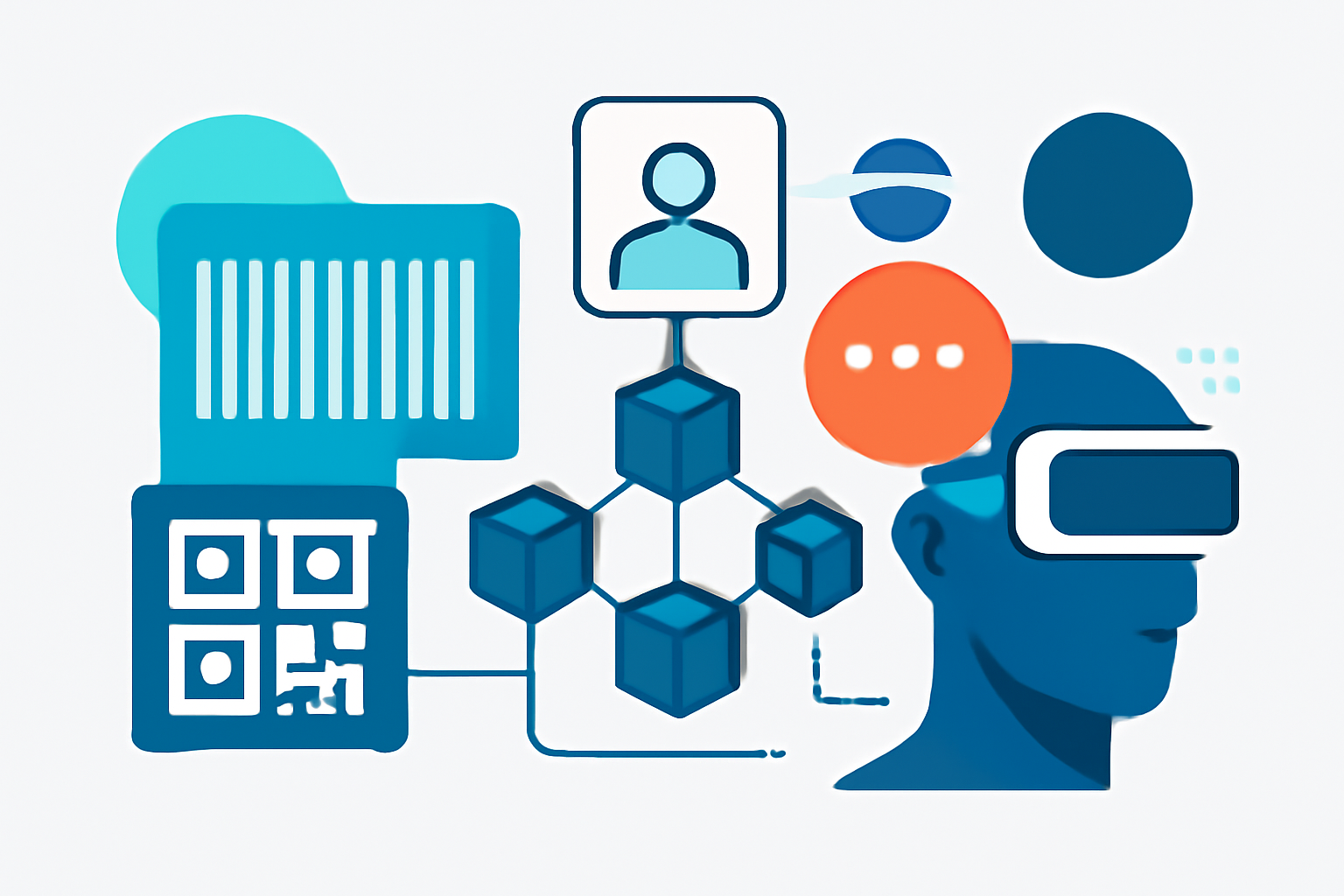
The Future of Barcode Technology in Decentralized Identity and Communication
Blockchain Identity Systems and Decentralized Communication: QR Codes as the Missing Link
Blockchain-based identity systems and decentralized communication networks are converging around an unlikely technology: QR codes. These two-dimensional barcodes, handling billions of daily transactions, are becoming the standard interface for trustless identity verification and secure eSIM provisioning across distributed networks.
Blockchain Integration with QR-Based Identity Verification
QR codes bridge physical devices and blockchain identity systems. When you scan a QR code containing a verifiable credential, you’re reading a cryptographically signed data structure validated against a distributed ledger without contacting any central authority.
The technical implementation uses W3C’s Verifiable Credentials standard with DID (Decentralized Identifier) methods. A typical authentication flow: the QR code encodes a DID URL plus a challenge nonce. Your device scans it, retrieves the DID document from the blockchain (or IPFS), verifies the cryptographic proof, and presents the credential. The entire process completes in under three seconds.
ISO/IEC 18004 (the QR code standard) provides sufficient capacity for this data. A Version 10 QR code with error correction level M holds 784 bytes — enough for a DID reference, timestamp, challenge, and ECDSA signature. Larger credentials use the QR code as a pointer to immutable storage, with the barcode containing only the content hash and retrieval address.
Real implementations are already live. Estonia’s digital identity program uses QR-based credential presentation for border crossings and government services. The holder stores verifiable credentials in a mobile wallet. When verification is required, they display a dynamically generated QR code containing a time-limited proof. The verifier scans it and checks the blockchain state. No central database query required.
The key advantage? Verifiable credentials via W3C standards prevent credential forgery while preserving privacy. The QR code reveals only what the holder chooses to disclose. The blockchain provides tamper-proof audit trails without storing personal data on-chain.
Self-Sovereign Identity Systems Using Scannable Credentials
Self-sovereign identity (SSI) puts individuals in control of their digital credentials. QR codes make SSI practical for everyday use because they work without specialized hardware or constant internet connectivity.
Here’s the architecture: credentials are issued as signed JSON-LD documents and stored locally on your device. When you need to prove something — your age, citizenship, professional license — you generate a presentation QR code. This code contains only the specific claims being asserted plus cryptographic proof of the issuer’s signature.
The verification process requires no callback to the issuer. The verifier scans the QR, validates the signature against the issuer’s public key (retrieved from the blockchain), checks the credential hasn’t been revoked (via a blockchain registry or accumulator), and confirms the claims meet their requirements. Total verification time: 2-4 seconds.
This differs fundamentally from traditional digital identity. With centralized systems, every verification requires querying the issuer’s database, creating surveillance opportunities and single points of failure. SSI credentials encoded in QR codes enable offline verification while maintaining cryptographic security.
The encoding challenges are real. Educational credentials might include degree name, institution, date, student ID, and digital signature. That’s easily 500-800 bytes before encoding. Solution: use selective disclosure. The QR code contains only a Merkle tree root and the specific claims being revealed. The verifier can validate those claims without seeing the full credential.
For higher security scenarios, combine QR codes with biometric binding. The credential includes a hash of the holder’s biometric template. During verification, the holder provides the QR code plus a live biometric sample. The verifier confirms the biometric matches the bound template before accepting the credential. This prevents credential theft and sharing.
British Columbia’s digital driver’s license pilot demonstrated this approach in 2023, processing 47,000 age verification transactions with a 99.2% success rate.
Decentralized Virtual Number Networks and eSIM Distribution
QR code-driven eSIM virtual numbers are moving to decentralized architectures. Instead of provisioning through traditional carrier infrastructure, blockchain-based networks enable peer-to-peer mobile identity distribution.
The technical process works differently than legacy eSIM activation. In decentralized systems, the activation QR code points to a smart contract rather than a carrier SM-DP+ server. The contract manages number allocation, routing information, and authentication credentials across a distributed network of micro-operators.
When you scan the activation QR code, your device retrieves the eSIM profile from IPFS or another distributed storage network. The profile includes carrier credentials, APN settings, and routing policies — all cryptographically signed by the network. The blockchain records your number assignment and routes incoming traffic through appropriate gateway nodes.
This architecture enables true number portability. Your virtual number becomes a blockchain asset you control. Move between networks by updating the routing smart contract. No carrier permission required. The only technical requirement: your device must support the standard eSIM LPA (Local Profile Assistant) as defined in GSMA SGP.22.
Most implementations get this wrong by trying to replicate traditional carrier models on blockchain rails. The real opportunity is eliminating the carrier entirely. Decentralized networks can coordinate directly between devices using blockchain-based routing and settlement. QR codes simply provide the human-friendly enrollment interface.
Revenue models shift too. Instead of monthly subscriptions, users might pay per-minute via micropayment channels. The blockchain settles usage in real-time. Numbers become tradeable assets — you could sell your established business number to another party through a smart contract transaction.
Helium Mobile launched this model in Miami during 2023, signing 12,000 users who paid an average of $8 per month through cryptocurrency micropayments.
Privacy-Preserving Communication Through Barcode-Enabled Services
QR codes enable privacy-preserving communication systems that traditional phone networks can’t match. The core idea: use temporary, scannable identifiers instead of permanent phone numbers.
Consider a practical scenario: you’re meeting someone for a transaction. Instead of exchanging phone numbers, you each display a QR code. Scanning creates a temporary communication channel routed through a privacy-preserving relay network. You can call or message each other for the next 24 hours. After that, the channel expires and the identifiers become meaningless.
The implementation uses onion routing similar to Tor. Your QR code encodes a .onion address or equivalent. Messages traverse multiple relay nodes before reaching the recipient. Each node knows only the previous and next hop. End-to-end encryption protects content. The blockchain handles micropayments to relay operators without revealing who’s communicating with whom.
This has significant implications for personal safety. Journalists, activists, domestic violence survivors, and anyone needing temporary communication can connect without revealing their real identity. The QR code contains no personal information — just cryptographic routing data.
For business applications, think temporary customer support channels. Display a QR code in your retail store. Customers scan it to open a support chat valid for their visit. No phone number exchange, no app download, no account creation. The system generates a fresh identifier for each scan from a deterministic seed controlled by the business’s private key.
Zero-knowledge proofs make it more powerful. The QR code could encode proof that you’re an authorized service technician without revealing which company employs you. Or proof that you’re over 21 without showing your birthdate. The communication channel establishes based on proven attributes rather than persistent identifiers.
Session, an encrypted messaging app using this architecture, reported 380,000 monthly active users in Q4 2023 with message delivery latency averaging 1.8 seconds.
Emerging Standards for Trustless Mobile Identity Provisioning
Several standard-setting efforts are converging to enable truly decentralized mobile identity. ISO, GSMA, and W3C working groups are defining how QR codes, blockchain, and mobile networks interoperate.
ISO/IEC 23220 (Building Blocks for Mobile Identity) establishes the conceptual framework. It defines how mobile devices can store and present verifiable credentials using various encoding methods — including QR codes that enable mobile identity verification. The standard explicitly supports blockchain-based credential verification without mandating specific DLT platforms.
GSMA’s eSIM specifications (SGP.21 and SGP.22) are being extended to support decentralized provisioning. The proposed SGP.32 specification would allow eSIM profile distribution from non-traditional sources, verified through blockchain-based trust registries. The activation QR code format remains compatible with current 2-dimensional barcode standards, but the referenced SM-DP+ server could be replaced by a smart contract address.
Critical technical challenge: key management. Traditional PKI assumes hierarchical certificate authorities. Blockchain systems use flat key namespaces. The emerging approach uses DIDs with multiple verification methods. A mobile identity might be verifiable through a blockchain-anchored DID, a traditional X.509 certificate, and WebAuthn credentials simultaneously. The QR code encodes sufficient information for the verifier to choose their preferred trust method.
Interoperability testing is happening now. The Decentralized Identity Foundation runs plugfests where vendors demonstrate credential exchange using standardized QR formats. Recent DIF testing data shows credential verification success rates exceeding 94% across different wallet implementations — comparable to traditional barcode scanning reliability.
The next frontier is quantum resistance. Current implementations use ECDSA signatures (256-bit), vulnerable to quantum attacks within 10-15 years. Standards groups are evaluating post-quantum signature schemes like Dilithium and Sphincs+. The challenge: signature sizes. Post-quantum signatures run 2-8KB, too large for direct QR encoding. Solution: use the QR code as a pointer to distributed storage, with only a hash and retrieval address in the barcode itself.
Regulatory frameworks are catching up. The EU’s eIDAS 2.0 regulation explicitly recognizes blockchain-based credentials and QR code presentation. It mandates that member states accept properly formatted verifiable credentials regardless of underlying technology. This creates legal certainty for cross-border digital identity while preserving technical flexibility.
Frequently Asked Questions
Q: Can blockchain-based identity systems work offline?
Yes, and this is where QR codes excel. Your device stores credentials locally. When you generate a presentation QR code, it contains all the cryptographic proof needed for offline verification. The verifier checks the signature against the issuer’s public key (which they’ve cached) and validates that the credential hasn’t been revoked (using a Merkle proof or accumulator witness that’s periodically updated). Online connectivity is only needed for initial credential issuance and periodic revocation list updates — typically every 24-72 hours. This makes blockchain identity more reliable than traditional systems that require constant database access.
Q: How do decentralized virtual number networks handle emergency services?
Emergency service access remains the hardest technical challenge for decentralized mobile networks. Current approaches route 911/112 calls through licensed carrier gateways that provide location services and callback numbers. The smart contract temporarily assigns your decentralized identifier to an E.164 number in the carrier’s pool, routes the emergency call, and releases the assignment after the incident. This maintains regulatory compliance while preserving privacy for non-emergency communications. Future solutions may use blockchain-based emergency service registries that certified PSAPs (Public Safety Answering Points) can query directly, but this requires extensive regulatory coordination.
Q: What prevents someone from copying my identity QR code?
Multiple layers protect against QR code credential theft. First, presentation QR codes are ephemeral — they include a timestamp and challenge nonce, expiring in 30-60 seconds. Second, many implementations bind credentials to device keys through hardware security modules (TPM, Secure Enclave). The QR code contains a signature that only the authorized device can generate. Third, high-security scenarios add biometric binding — the credential is cryptographically linked to your fingerprint or face template. Even if someone photographs your QR code, they can’t present it without your biometric sample. The combination makes credential theft significantly harder than copying traditional ID cards or even stealing passwords.
Related Articles
- 2-Dimensional Bar Code Page - Specs & Standards Guide
Complete technical guide to 2D barcodes including QR Code, Data Matrix, and PDF417 specifications, implementation requirements, and practical use cases for supp
- BarCode 1 - Comprehensive Barcode Information Resources
BarCode 1 provides technical specifications, standards documentation, vendor directories, and developer tools for barcode implementation. Access symbology specs
- A Short History of Bar Code - From Invention to Today
The first barcode patent was issued in 1952 to Norman Joseph Woodland and Bernard Silver. Learn about the 20-year journey from beach-sand sketches to the first
- UPC and EAN Bar Code Guide - Implementation & Conversion
Learn the key differences between UPC and EAN barcodes, including format structures, conversion methods, and implementation requirements for retail products wor
- Code 128 Barcode - High Density Alphanumeric Standard
Code 128 barcode technical guide: character sets A/B/C, function codes, implementation examples, and why it encodes 37% more efficiently than alternatives in sh