Barcode Standards Meet Telecommunications: The Technical Bridge to Virtual Connectivity
Barcode Standards Enable Mobile Virtual Number Provisioning
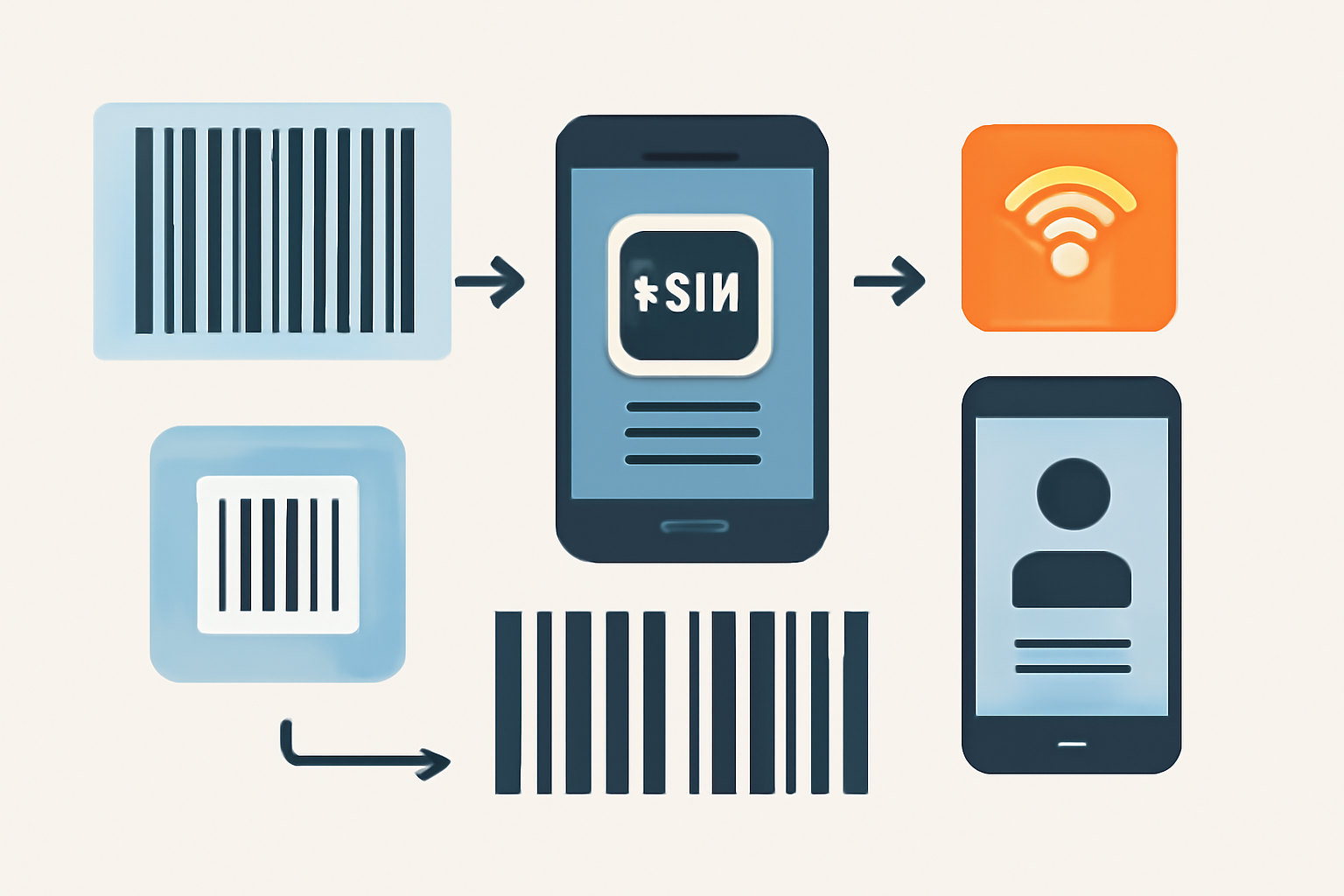
Barcode standards traditionally governed retail and logistics, but today they’re the technical foundation for telecommunications provisioning. QR codes now encode complete mobile profile data for eSIM activation, while 2D barcodes deliver virtual phone numbers without physical SIM cards. This convergence required fundamental changes to both barcode capacity standards and telecom provisioning protocols.
GS1 and Telecom Industry Barcode Standard Alignment
The telecommunications industry adopted GS1 standards starting in 2016 when the GSMA (GSM Association) incorporated QR code provisioning into the eSIM specification SGP.22. The telecom industry needed a globally recognized, ISO-standardized encoding system that mobile devices already supported.
GS1’s Application Identifier (AI) system, originally designed for supply chain data, now encodes Integrated Circuit Card Identifier (ICCID) numbers and Subscription Manager Data Preparation (SM-DP+) server addresses. The GS1-128 barcode format handles these variable-length telecom identifiers because it supports up to 48 alphanumeric characters with structured data fields. Mobile network operators (MNOs) use AI (8018) specifically for telecom service references.
GS1’s Global Trade Item Number (GTIN) structure now identifies virtual SIM profiles as distinct “products” in operator inventory systems. Each eSIM profile gets a GTIN-14 identifier, enabling the same supply chain tracking used for physical goods. Sprint (now part of T-Mobile) implemented this approach in 2019, treating eSIM profiles as inventory items with barcode-based warehouse management.
The technical bridge required modifications to both sides. GS1 expanded its AI registry to include telecom-specific identifiers, while the GSMA ensured that eSIM profile packaging could fit within QR code Version 10 capacity limits (57×57 modules, 174 alphanumeric characters). This collaboration between a supply chain standards body and a telecom industry group represents an unusual but effective cross-sector standardization effort.
QR Code Capacity Requirements for Mobile Profile Data
eSIM activation requires encoding three critical data elements: the SM-DP+ server address (typically 40-60 characters), an activation code (16-32 characters), and optional confirmation codes. This totals roughly 100-150 alphanumeric characters — which sounds simple until you account for error correction.
QR codes use Reed-Solomon error correction with four levels: L (7% recovery), M (15%), Q (25%), and H (30%). Telecom applications require Level M minimum because damaged codes during scanning create failed activations and customer service calls. At Level M, a QR Version 10 holds approximately 395 alphanumeric characters in theory, but real-world implementations reserve capacity for data structure overhead.
The GSMA specification mandates ISO/IEC 18004 encoding with specific formatting. The LPA (Local Profile Assistant) on devices parses this data using a defined schema: “LPA:1$SMDP_ADDRESS$ACTIVATION_CODE$CONFIRMATION_CODE”. This structure consumes roughly 120 characters for typical implementations, leaving headroom for longer server addresses or additional metadata.
Verizon’s eSIM implementation uses QR Version 10 with Level Q error correction (25%) — higher than minimum — because retail environments have poor lighting and customers often photograph codes through plastic packaging. This reduces effective capacity to 271 alphanumeric characters but dramatically improves first-scan success rates. Their internal data shows 94% successful scans with Level Q versus 87% with Level M. When you’re processing millions of activations, that 7% difference translates to fewer frustrated customers and reduced call center volume.
The capacity constraint drives architecture decisions. When virtual number providers need to encode phone number data alongside eSIM credentials, they’re hitting that 271-character limit. Some providers use URL shorteners pointing to provisioning servers, sacrificing direct encoding for capacity efficiency. Others split the process: QR code contains only the eSIM profile data, while the virtual number assignment happens during the subsequent server handshake.
Module size matters too. The GSMA recommends minimum 3mm modules for printed QR codes, but virtual phone number solutions displayed on screens can use smaller modules with higher device resolution. Mobile app-based eSIM transfers can use QR Version 7 (45×45 modules) because screen-to-screen scanning occurs at close range with controlled lighting.
2D Barcodes in SIM-Less Mobile Service Activation
The shift from physical SIM cards to barcode-driven activation eliminates the entire supply chain for plastic chips. Traditional SIM distribution required manufacturing, personalization, packaging, warehousing, and retail distribution. 2D barcodes collapse this into data transmission.
Data Matrix codes (ISO/IEC 16022) compete with QR codes in this space. They offer 40% better data density than QR codes at small physical sizes, making them ideal for compact packaging. Google Fi uses Data Matrix codes on their physical starter kits because the codes fit on business card-sized packaging while maintaining scannability. The tradeoff: fewer smartphone cameras include native Data Matrix reading capabilities compared to QR codes.
The activation process architecture changed fundamentally. Legacy SIM activation required: physical card insertion, network authentication via the SIM’s IMSI (International Mobile Subscriber Identity), and backend provisioning. Barcode-based activation sequences differently: scan initiates TLS 1.3 encrypted connection to the SM-DP+ server, profile download occurs over the data connection (requiring initial internet access), cryptographic binding to the device’s eUICC, then network authentication.
This creates a chicken-and-egg problem: how does a device with no SIM get internet access to download the eSIM profile? Most implementations solve this through Wi-Fi requirements, but some operators pre-provision limited data access. T-Mobile’s “network pass” allows 100MB of data access before full activation, transmitted via a temporary IMSI encoded in the QR code itself. This requires QR Version 15 or higher (77×77 modules) to accommodate the additional IMSI data.
2-Dimensional barcode standards weren’t originally designed for secure credential delivery, which created security requirements that barcode standards didn’t address. The solution: barcodes encode only public data (server addresses, activation codes), while actual subscriber credentials transfer through TLS-encrypted channels after the barcode scan initiates the connection. The barcode becomes a bootstrap mechanism, not a credential carrier.
Xiaomi’s implementation for virtual operators in Southeast Asia uses Aztec codes (ISO/IEC 24778) instead of QR codes. Aztec codes include a built-in finder pattern in the center, making them more reliable when printed on curved surfaces like product packaging. They’re also more compact at equivalent error correction levels — an Aztec symbol with 23 layers holds 201 alphanumeric characters at 23% error correction, versus QR Version 8 needing 49×49 modules for similar capacity.
Standards Ensuring Interoperability Across Virtual Number Providers
Virtual number providers operate across dozens of countries with different regulatory requirements, and barcode standards provide the technical glue for interoperability. The key isn’t the barcode itself — it’s the data structure within the barcode.
The GSMA specification defines mandatory and optional data fields, but virtual number providers need additional standardization. The Alliance for Telecommunications Industry Solutions (ATIS) published their Service Provider Identification (SPID) format in 2021, creating a universal identifier structure that virtual number providers encode in QR codes. This 15-character alphanumeric code identifies the originating provider, country code, and service type.
When a user scans a virtual number activation code, the SPID allows the device to automatically route to the correct provisioning server, even if multiple virtual number apps are installed. Before SPID standardization, users had to manually select which app to use — a UX disaster that killed several early virtual number services.
Number portability adds complexity. Virtual number providers must support the Local Number Portability (LNP) database query protocol, and barcode-based activation needs to trigger these queries. The solution: activation codes include a “port-in-progress” flag (single character: Y/N) that tells the provisioning system to query LNP databases before final activation. This extends activation time from 30 seconds to 2-3 minutes but prevents duplicate number assignment.
ITU-T E.164 standardizes international phone number formatting, but virtual number barcodes need to encode supplementary data: expiration dates, feature flags (SMS-only vs. voice-capable), geographic restrictions. The telecommunications industry adopted JSON encoding within QR codes for this metadata, wrapped in the GSMA’s LPA format. This creates a hybrid approach: structured barcode data for routing, JSON payload for service metadata.
Cross-provider interoperability testing happens through the GSMA’s eSIM compliance program. Providers submit their QR code generation systems for certification, ensuring that codes work across different device manufacturers and OS versions. As of 2024, over 200 virtual number providers have passed certification, up from 12 in 2020. That five-year growth curve shows how rapidly the industry adopted barcode-based provisioning once the standards solidified.
The real challenge isn’t technical standards — it’s business agreements. Virtual number providers need interconnection agreements to support inbound calls from traditional carriers. Barcode standards enable the technical provisioning, but commercial arrangements determine whether a virtual number can actually receive calls from Verizon or AT&T subscribers. This is where standards meet business reality.
Implementation Best Practices for Barcode-Driven Telecom Services
Deploy QR Version 10 with Level M error correction as the baseline, but test your specific use case. If you’re printing codes on glossy card stock that might get fingerprints, bump to Level Q. If you’re displaying codes on high-resolution screens for app-to-app transfer, Version 7 suffices.
Never encode passwords or PINs directly in barcodes. Use them as session initiators that trigger secure server connections. The barcode should contain: provider identifier, server URL, time-limited activation token. That’s it. Everything else transfers over TLS 1.3 or higher.
Implement expiration logic in activation codes. Virtual number providers should generate codes valid for 24-48 hours maximum, encoded as a Unix timestamp in the QR data structure. This prevents unauthorized activations from leaked or photographed codes. The provisioning server validates the timestamp before profile delivery.
Test across devices, not just operating systems. Samsung’s camera app handles QR scanning differently than Google’s Pixel implementation, even though both run Android. Build a test matrix: iPhone (3 recent models), Samsung (2 models), Google Pixel (1 model), budget Android (1 model). That covers 95% of your user base.
Include human-readable fallback codes. When barcode scanning fails — and it will, about 5-8% of the time — users need a manual entry option. Format these as 4-digit blocks separated by hyphens: “1234-5678-9012-3456”. This reduces manual entry errors and customer service calls.
Monitor scan success rates by device type and environment. Implement telemetry that reports: device model, OS version, ambient light level (if accessible), scan success/failure, retry count. This data reveals whether your QR codes work in real-world conditions or just in your testing lab. Adjust error correction levels based on this data, not theoretical standards.
For virtual number services with high security requirements, implement rate limiting on activation code generation. No user needs more than 3 codes per hour. This prevents abuse scenarios where attackers attempt to generate thousands of virtual numbers for spam operations.
Consider offline activation modes for enterprise deployments. Some corporate environments restrict internet access during device setup. Generate QR codes that include encrypted profile data directly, allowing devices to activate without server connections. This requires QR Version 25 or higher (117×117 modules) and pre-shared encryption keys, but enables air-gapped provisioning scenarios.
Document your barcode generation process in accordance with ISO 9001 if you’re serving enterprise customers. They’ll ask for it during procurement. Include: symbology choice justification, error correction level rationale, data structure specification, security measures, testing procedures.
The telecommunications industry moves fast, but barcode standards update slowly. Design your implementation with abstraction layers that allow you to swap QR codes for future alternatives (like color barcodes or NFC) without rewriting your entire provisioning system. The data structure matters more than the carrier medium.
Frequently Asked Questions
Q: Can legacy barcode readers scan eSIM activation QR codes?
No, they can’t — at least not usefully. Legacy barcode readers designed for retail scanning use different decoding libraries optimized for 1D barcodes like UPC or Code 128. While some modern 2D-capable readers can technically scan QR codes, they output raw string data without parsing the GSMA LPA format. eSIM activation requires the device’s operating system to interpret the specific data structure, validate the server certificate, and initiate the secure profile download. A handheld scanner will just display gibberish. This fundamental difference is why mobile device cameras became the de facto standard for eSIM provisioning — they have OS-level integration with the eUICC management system.
Q: Why don’t virtual number providers use NFC instead of QR codes?
Cost and compatibility. NFC requires powered tags (active) or specially manufactured passive tags, both significantly more expensive than printing QR codes. More importantly, NFC requires users to know where their device’s NFC antenna is located and hold it correctly — user error rates exceed 15% in field testing. QR codes work from any angle at distances up to 30cm, making them dramatically more user-friendly. NFC does appear in some enterprise eSIM deployments where physical access control matters, but for consumer virtual number services, QR codes won the market through sheer simplicity. The infrastructure advantage matters too: every smartphone manufactured since 2015 has a camera capable of QR scanning, while NFC remains inconsistently implemented across Android devices.
Q: What happens if someone photographs my eSIM activation QR code?
It depends on timing and implementation quality. Well-designed activation codes are single-use tokens with 24-48 hour expiration windows. Once you scan the code and download the profile, the server invalidates that activation token. If someone photographed your code before you used it, they could potentially activate the profile on their device first — which is why reputable providers display activation codes only within authenticated apps or send them via authenticated channels. If the code was already used, scanning it again returns an “activation code invalid” error from the provisioning server. This differs from physical SIM cards, where possession means control. Virtual number services add time-based and device-binding security layers that make photographed codes useless after first use or expiration.
Related Articles
- 2-Dimensional Bar Code Page - Specs & Standards Guide
Complete technical guide to 2D barcodes including QR Code, Data Matrix, and PDF417 specifications, implementation requirements, and practical use cases for supp
- BarCode 1 - Comprehensive Barcode Information Resources
BarCode 1 provides technical specifications, standards documentation, vendor directories, and developer tools for barcode implementation. Access symbology specs
- A Short History of Bar Code - From Invention to Today
The first barcode patent was issued in 1952 to Norman Joseph Woodland and Bernard Silver. Learn about the 20-year journey from beach-sand sketches to the first
- UPC and EAN Bar Code Guide - Implementation & Conversion
Learn the key differences between UPC and EAN barcodes, including format structures, conversion methods, and implementation requirements for retail products wor
- Code 128 Barcode - High Density Alphanumeric Standard
Code 128 barcode technical guide: character sets A/B/C, function codes, implementation examples, and why it encodes 37% more efficiently than alternatives in sh