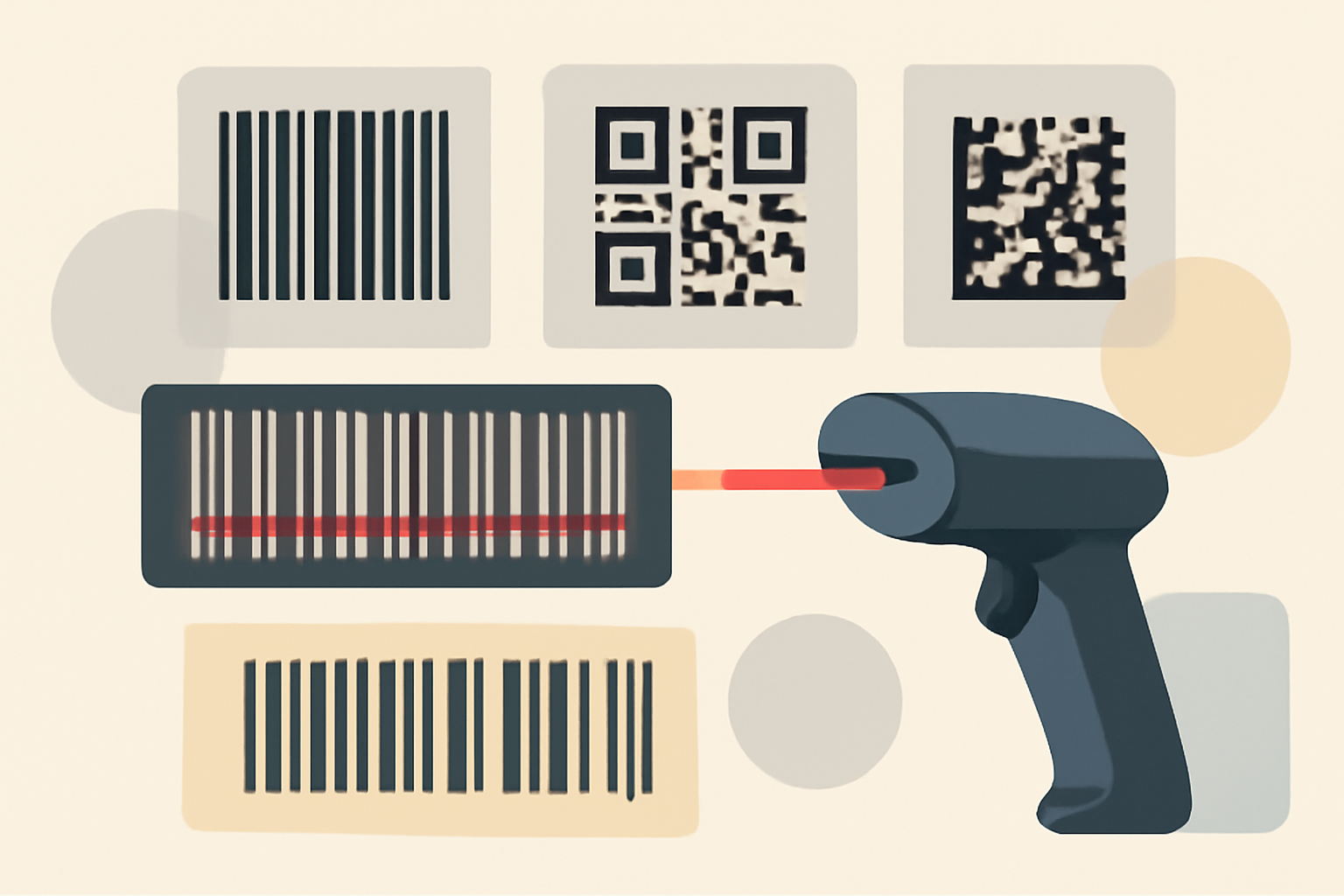
Barcode Standards and Technology
Barcode standards represent a mature technology ecosystem built on three foundational elements: symbology specifications, data structure standards, and application identifiers. Every barcode you scan—whether on a retail product, shipping carton, or medical device—follows protocols established by ISO/IEC committees and industry organizations like GS1, ensuring that a scanner in Tokyo reads the same data as one in Toronto.
Linear Barcode Symbologies: The Core Standards
Linear barcodes encode data in parallel lines of varying widths. Code 39 dominates internal inventory systems because it’s self-checking, handles alphanumeric data, and requires no licensing. Manufacturing plants use it for work-in-process tracking; warehouses print it on pick tickets. The tradeoff? It’s a space hog—expect roughly 0.5 inches per ten characters at standard density.
Code 128 packs significantly more data into less space through its three character sets and function codes. Shipping labels universally adopt Code 128 because it efficiently encodes variable-length data like serial numbers and batch codes. UCC/EAN-128 (now called GS1-128) extends Code 128 with application identifiers that structure supply chain data—shipment tracking numbers (AI 00), expiration dates (AI 17), lot numbers (AI 10).
UPC and EAN codes serve a specific purpose: fixed-length product identification at point-of-sale. UPC-A’s 12 digits encode manufacturer and product codes with a modulo-10 check digit. EAN-13 adds a country prefix. These symbologies can’t encode arbitrary data—they’re lookup keys to product databases. Retailers demand them; manufacturers license them through GS1.
Interleaved 2 of 5 encodes numeric-only data in paired digits, making it compact for carton marking and warehouse receiving. The catch: it requires even digit counts and produces read errors if partially scanned. Always use bearer bars (solid rectangles around the symbol) to prevent short scans.
Two-Dimensional Barcode Standards
2D barcodes broke the linear limitation by stacking data vertically or using matrix patterns. Data Matrix (ISO/IEC 16022) fits substantial data in tiny spaces—medical devices use it for UDI compliance, where a 3mm square encodes device identifiers, lot numbers, and expiration dates. Semiconductor manufacturers etch Data Matrix directly onto chips at microscopic scales.
QR Code (ISO/IEC 18004) provides built-in error correction through Reed-Solomon algorithms. Damage up to 30% of the symbol? It still scans. This resilience matters for outdoor applications, printed receipts, and marketing materials. The automotive industry standardized on QR codes for parts tracking because symbols survive harsh manufacturing environments. The same scan-to-provision pattern now drives mobile connectivity: activating an eSIM profile means scanning a QR code, which is how online phone numbers get issued without a physical SIM.
PDF417 (ISO/IEC 15438) operates as a portable data file—driver’s licenses encode your photo and biometric data in the barcode itself, no database required. It’s overkill for simple identification but essential when you need to move complete records through systems with limited connectivity.
ISO/IEC Standards Framework
Every viable barcode symbology has an ISO/IEC specification defining symbol structure, encoding rules, and print quality parameters. Code 128 follows ISO/IEC 15417. Data Matrix follows ISO/IEC 16022. These specifications ensure a symbol printed in Germany decodes identically in Singapore.
Print quality standards matter more than most realize. ISO/IEC 15416 specifies how to grade linear barcodes on ten parameters including edge contrast, modulation, and defects. Grades run from A (4.0) to F (0.0). Most retailers require Grade C minimum. Pharmaceutical track-and-trace regulations mandate Grade B. Use a verifier, not a scanner, to measure these parameters—scanners compensate for poor quality; verifiers measure what the standard requires.
The ISO/IEC 15394 standard governs how to structure data in 2D symbols for supply chain applications, defining where to place GTINs, batch numbers, and serial numbers so any compliant system extracts data consistently.
Application-Specific Standards and Protocols
Different industries layer their own standards atop symbology specifications. Healthcare follows GS1 standards for UDI—every medical device sold in the US carries a unique identifier in a specific format. Pharmaceutical serialization (Drug Supply Chain Security Act compliance) requires specific application identifiers in GS1-128 or Data Matrix.
The automotive industry adopted VDA 4902 for parts labeling, specifying exactly how suppliers mark components. AIAG standards govern North American automotive supply chains with similar specificity. Aerospace uses ATA Spec 2000 and MIL-STD-130 for parts marking, often requiring direct part marking through laser etching or dot peening.
Retail has the tightest barcode requirements—the UPC system became the de facto global standard through market pressure, not technical superiority. Retailers demand UPC-A or EAN-13 on consumer units, GS1-128 on shipping cartons, and EDI integration linking barcode scans to electronic transactions.
Selecting the Right Barcode Technology
Match symbology to your data requirements first. Numeric-only data? Consider Interleaved 2 of 5 or UPC/EAN. Alphanumeric with moderate length? Code 39 or Code 128. Need to embed complete records? PDF417 or Data Matrix. Require maximum damage resistance? QR Code with high error correction.
Space constraints drive many decisions. Retail shelf labels have room for UPC-A. Medical syringes don’t—Data Matrix wins. Print method matters too: thermal transfer produces sharp edges necessary for high-density symbols; dot matrix printers struggle with Code 128 at small sizes.
Frankly, most implementations fail because they skip verification. You need a barcode verifier that measures ISO parameters, not just a scanner that beeps. Print samples at your target size, verify them, then validate readability across your actual scanner population. Different scanner models decode differently—test with the cheapest scanner in your facility, not the newest one.
Consider your growth path. Starting with Code 39 seems simple, but switching to Code 128 later means reprinting everything and updating systems. Data Matrix provides future flexibility for serialization requirements you might not have today.
Practical Implementation Realities
Every barcode project hinges on print quality and scan environment. Resolution requirements scale with symbology—Code 39 tolerates 203 DPI thermal printers; Code 128 at small sizes needs 300 DPI minimum; Data Matrix often requires 600 DPI for reliable scanning. Test print samples at your lowest-quality printer before committing to a symbology.
Barcode scanning equipment capabilities vary dramatically. Laser scanners read linear codes only. 2D imagers read everything but cost more. If you’re marking metal parts in a machine shop, consider the scanner’s depth of field and ability to read symbols at angles.
Label materials and adhesives affect scan reliability as much as symbology choice. Glossy labels create specular reflection that confuses scanners. Curved surfaces distort symbols. Temperature extremes fade thermal prints. Match your media to your environment—this isn’t the place to save money.
The most successful implementations separate human-readable interpretation from barcode data. Print the decoded data below the symbol so workers can verify scans and manually enter data when scanners fail. System redundancy matters—have backup scanners and manual processes for when technology fails.
Standards exist for good reasons, but the complete specifications documentation reveals details that separate working systems from failing ones. Read the actual ISO standards, not marketing summaries. Test exhaustively. Verify continuously. That’s how barcode systems achieve the 99.9%+ read rates the technology promises.
All Articles
- 2-Dimensional Bar Code Page - Specs & Standards Guide
Complete technical guide to 2D barcodes including QR Code, Data Matrix, and PDF417 specifications, implementation requirements, and practical use cases for supp
- BarCode 1 - Comprehensive Barcode Information Resources
BarCode 1 provides technical specifications, standards documentation, vendor directories, and developer tools for barcode implementation. Access symbology specs
- A Short History of Bar Code - From Invention to Today
The first barcode patent was issued in 1952 to Norman Joseph Woodland and Bernard Silver. Learn about the 20-year journey from beach-sand sketches to the first
- UPC and EAN Bar Code Guide - Implementation & Conversion
Learn the key differences between UPC and EAN barcodes, including format structures, conversion methods, and implementation requirements for retail products wor
- Code 128 Barcode - High Density Alphanumeric Standard
Code 128 barcode technical guide: character sets A/B/C, function codes, implementation examples, and why it encodes 37% more efficiently than alternatives in sh
- Barcode Plugins and VBX Controls - Developer Resources
Barcode plugins, VBX controls, and ActiveX components for developers. Compare browser extensions, SDKs, and integration tools for embedding barcode generation i
- US Patent 2,612,994 - First Barcode Patent (1952)
US Patent 2,612,994, granted October 7, 1952, was the first barcode patent. Norman Woodland and Bernard Silver invented the bulls-eye pattern system that launch
- Code 128 XML Reference - Structured Specification Data
Learn how XML schemas represent Code 128 barcode specifications with machine-readable formats for automated validation, GS1-128 integration, and enterprise syst
- Bar Code Programs For Unix & Linux - Software Guide
Discover Unix and Linux barcode generation tools including GNU Barcode, BWIPP, and command-line utilities for automated label printing and enterprise workflows.
- Barcode Readers and Scanners - Equipment Guide
Compare barcode scanner types, technologies, and selection criteria for retail, warehouse, and industrial applications. Includes integration guides and real-wor
- BarCode1 FAQ - Frequently Asked Questions About Barcodes
Expert answers to common barcode questions covering error rates (1 in 3 million vs 1 in 300 manual), symbology selection, troubleshooting, and implementation be
- Patent 2,612,994 PDF - Original Barcode Invention
US Patent 2,612,994, filed October 20, 1949 by Woodland and Silver, established the first barcode system using concentric circles—the technical foundation for m
- US Patent 4,745,269 - Dot Code A Barcode Patent
US Patent 4,745,269 introduced Dot Code A in 1988, pioneering matrix barcode technology with circular dots. Learn about its technical specifications, expiration
- Patent 2,612,994 - Classifying Apparatus and Method PDF
Patent 2,612,994, granted October 7, 1952, documented Woodland and Silver's original barcode invention using optical patterns for automatic product identificati
- Code 39 Barcode - Complete Specification & Guide
Code 39 barcode symbology explained: encoding structure, implementation rules, applications in automotive and healthcare, and practical examples with width rati